Published:
15.01.2026



E-commerce is facing a fundamental change. Not because there is a new marketplace or another shop feature, but because the nature How people find, compare, and buy products, just rearranged. Search queries become dialogs. Product research becomes advice. And buying decisions are made in the midst of conversations with AI systems.
It is precisely for this new reality that google At the beginning of 2026, the Universal Commerce Protocol (UCP) presented: an open standard that makes commerce fit for agentic, AI-driven experiences.
This article explains from the ground up:
The target group is marketing, e-commerce and product managers in industry and retail, who must make decisions today that should still bear fruit in two to three years.
E-commerce systems have grown historically. Product data is in PIM, prices in ERP, images in DAM, checkout in the shop, payments with third-party providers. This works — as long as the customer actively visits a shop and clicks through pages.
But that is exactly what is changing.
More and more buying decisions no longer start in the shop, but:
There, users don't expect product lists, but specific answers:
“Which product is right for my application? ”
“Is this available in my region, at my budget, in my preferred variant? ”
“Can I buy it right now? ”
To make this possible, it is not enough to provide a feed somewhere. It takes a common language, which allows AI systems and business systems to talk to each other in a structured way.
This is exactly where UCP comes in.
that Universal Commerce Protocol Is a open, open-source standard, which depicts the entire commerce process — from product discovery to variants, prices and availability to checkout, payment and order management.
Important here:
UCP is not a marketplace and no shop system.
It is a abstraction layer, which connects existing systems.
You can think of UCP as a common grammar for commerce. Instead of building a separate integration for each platform, there is a standardized way to provide capabilities:
This massively reduces complexity on the corporate side — and makes commerce real for the first time agent-enabled.
The term “agent” sounds abstract but is easy to explain.
An agent is an AI system that acts on behalf of a user. Not only answers, but also takes on tasks. For example:
Instead of people clicking on every step themselves, they delegate goal and context to an agent.
For this to work, the agent must understand:
UCP provides the technical basis for this. Using standardized profiles, the agent discovers which capabilities a company offers and can use them securely — without individual special solutions.
From a technical point of view, UCP solves many integration problems. Strategically, however, it shifts something much more important: the value of product content.
In agentic commerce experiences, it is no longer enough to “represent” a product. Content must:
An agent can only recommend that What he understands. And understanding doesn't just mean measures and prices, but also:
This means that product images, visualizations, scenes, animations and metadata are not added, but functional part of the commerce flow.
Traditional industrial and commercial companies in particular face a structural problem here:
Classic photo production doesn't scale for that. And certainly not manual content maintenance.
UCP is increasing this pressure because content no longer just has to be “beautiful”, but Situationally retrievable, combinable and Can be used automatically.
That's where RenderThat comes in.
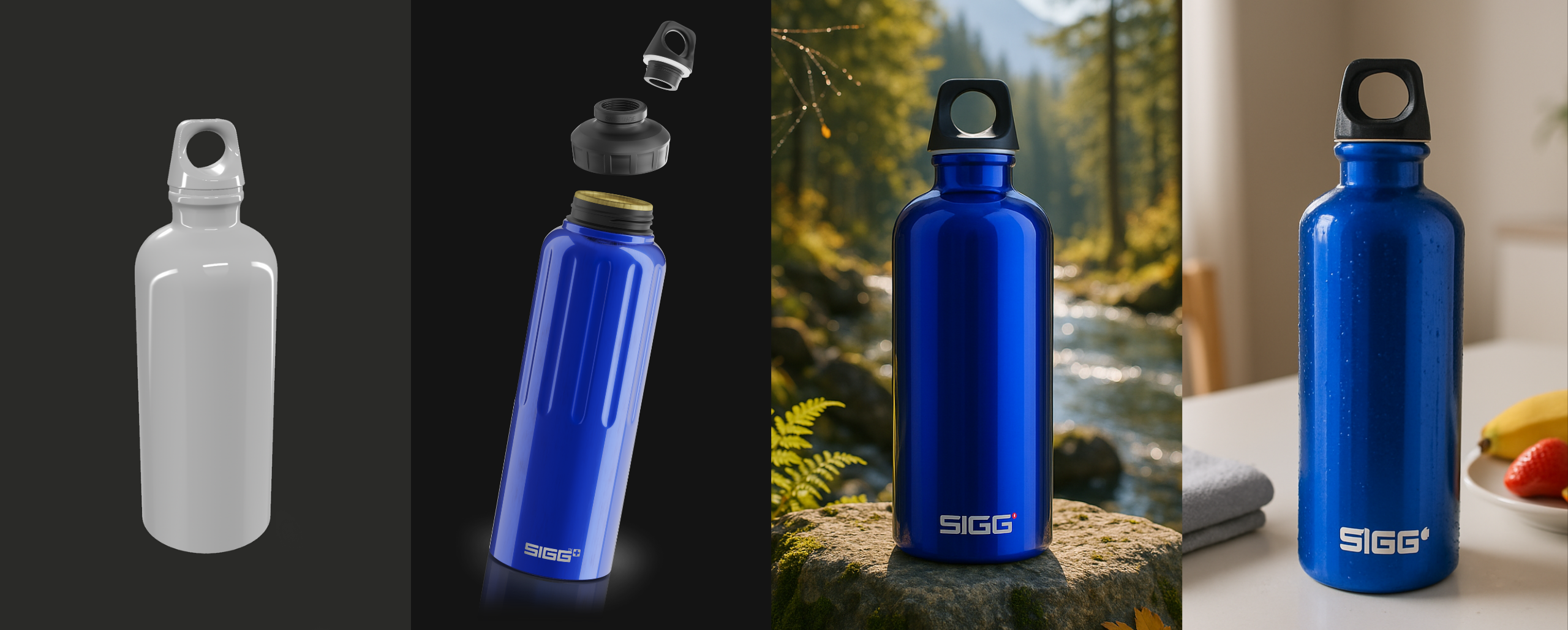
RenderThat creates visual product content that is not created in isolation, but from the start systemically thought is.
Once products are cleanly set up digitally — as digital twins — and then you can:
— vary as required
— localize for different markets
— embed into new usage scenarios
— recombine visually and in terms of content
That is exactly the type of content logic that agentic commerce requires.
Our core competency — the scalable rendering of large portfolios — creates a stable basis for providing products consistently, up to date and machine-ready. A product no longer exists as a single image, but as content system.
With RenderThat HUB, we are already centrally managing data, variants, approvals and assets. In perspective, this structure can be UCP standards adapt so that product information and visuals can be generated and displayed directly with the help of AI.
Our content flow engine combines existing visualizations with AI-powered image generation. This results in:
Exactly what an agent needs to give a user The right product in the right context to show.
We're already working with AI agents that access production and content workflows. This know-how can be transferred directly to agentic commerce scenarios — from content briefing to automated delivery.
UCP won't replace e-commerce overnight. But it will him fundamentally change. Companies that start early on to build up their product data and content in a structured, scalable and agent-enabled way are gaining a massive advantage.
It's not about changing everything tomorrow. But that's why:
The Universal Commerce Protocol is more than just a technical standard. It is a signal of where commerce is heading: away from isolated shops, towards contextual, AI-driven buying moments.
Product content becomes the connecting element between brand, system and user. And this is exactly where the power of RenderThat lies.
We are looking forward to exchanging ideas with companies that want to start preparing their digital presence for this new reality today. UCP will play a central role in e-commerce of the future — and we are convinced that anyone who invests now won't have to chase after it later.
If you are curious about how your product world can become UCP-compatible, talk to us.
For further explaination or discussion in the team, we recommend Googles official announcement / blog post, here
Discover other exciting content about 3D visualization of products.


We help companies digitize product portfolios with hundreds of items. Our workflows are tailored to your company and ensure maximum output with minimal effort.